B2B SaaS SEO Strategy: From Organic Traffic to Demo Requests
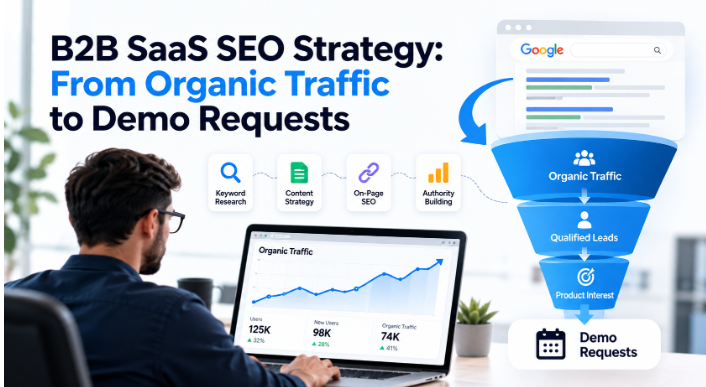
B2B SaaS companies often invest in SEO to increase website traffic, improve search visibility, and attract potential customers. However, more organic traffic does not automatically translate into more product demos, sales-qualified leads, or recurring revenue.
The real opportunity lies in attracting people who are actively researching a solution, helping them understand its value, and guiding them toward a meaningful next step.
A well-planned B2B SaaS SEO strategy connects keyword research, technical SEO, product-led content, landing page optimization, and conversion tracking to generate measurable business outcomes.
Whether you are a growing software startup or an established technology company, SEO can help you reach decision-makers throughout their buying journey.
In this guide, we will explore how to build a SaaS SEO strategy that moves beyond rankings and traffic to generate qualified demo requests.
Looking to improve your SaaS website’s organic performance? Start with a focused SEO audit to identify ranking opportunities, conversion barriers, and content gaps.
What Is B2B SaaS SEO?
B2B SaaS SEO is the process of optimizing a software company’s website and content to attract relevant business users through organic search.
Unlike general SEO, which may prioritize broad traffic growth, SaaS SEO should connect search visibility with the buying journey of business decision-makers.
For example, someone searching for “what is workflow automation” may be researching a topic, while someone searching for “workflow automation software for enterprises” may be evaluating products.
Both searches can be valuable, but they require different content and conversion strategies.
An effective B2B SaaS SEO program focuses on five core areas:
- Search intent: Understanding what potential buyers want to accomplish.
- Technical SEO: Making important pages accessible, crawlable, and indexable.
- Content strategy: Creating useful resources for each stage of the buyer journey.
- Conversion optimization: Helping visitors move from research to product evaluation.
- Performance measurement: Tracking qualified leads and demo requests alongside organic traffic.
The objective is not simply to attract more visitors. It is to attract the right visitors and give them a compelling reason to take action.
Why Organic Traffic Doesn’t Always Generate SaaS Demo Requests
A SaaS website can rank for hundreds of keywords and still struggle to generate qualified leads.
This usually happens when traffic acquisition and conversion optimization are treated as separate activities.
1. Targeting informational keywords without a conversion journey
Educational blogs can attract substantial traffic, but visitors may not be ready to evaluate a product.
For example, a blog explaining “what is CRM software” serves a different intent from a page targeting “CRM software for B2B sales teams.”
The solution is to connect informational articles with relevant product pages, comparison guides, use cases, and consultation opportunities.
2. Attracting the wrong audience
Broad keywords can bring visitors who are students, job seekers, individual consumers, or businesses outside your target market.
Your keyword strategy should reflect the problems your software solves, the industries you serve, and the size of businesses most likely to become customers.
3. Weak product and service pages
A visitor who reaches a product page needs to understand what the software does, who it is for, and why it is worth evaluating.
Product pages should clearly communicate:
- The problem the software solves
- Key features and business benefits
- Relevant integrations and use cases
- Security or compliance information where applicable
- Customer evidence and product screenshots
- A clear demo or trial CTA
4. Missing conversion tracking
Without proper measurement, you may know which blogs generate clicks but not which pages contribute to qualified enquiries or sales opportunities.
Connect organic landing-page data with form submissions, demo bookings, CRM records, and lead qualification.
How to Build a B2B SaaS SEO Strategy That Generates Demo Requests
A reliable strategy combines keyword targeting, website optimization, and conversion-focused content.
Step 1: Identify high-intent SaaS keywords
Begin with the search terms potential buyers use when they identify a problem, compare solutions, or evaluate software providers.
Organize your keyword research into three groups.
Informational keywords
These attract people researching a problem or learning about a solution.
Examples:
- What is sales automation software?
- How does workflow automation work?
- Benefits of cloud-based project management software
Commercial investigation keywords
These attract people comparing approaches or evaluating providers.
Examples:
- Best CRM software for B2B companies
- Workflow automation tools comparison
- Cloud software implementation services
Transactional and solution-focused keywords
These are often closer to product evaluation or purchase.
Examples:
- Enterprise CRM software demo
- Book a SaaS product demo
- Sales automation software pricing
Prioritize keywords based on relevance, actual search demand, business value, competition, and your existing search performance—not search volume alone.
For a SaaS company targeting India, relevant geographic and industry modifiers may also help. However, use location-specific keywords only when they match the company’s genuine target market and service offering.
Step 2: Map keywords to the right URLs
Keyword mapping prevents multiple pages from competing unnecessarily for the same search intent.
A practical SaaS website structure could look like this:
| Page type | Target intent | Primary conversion |
| Homepage | Core product category | Explore product or book demo |
| Product page | Specific software solution | Request a demo |
| Feature page | Individual capability | Explore feature or book demo |
| Industry page | Industry-specific problem | Request consultation |
| Comparison page | Evaluating alternatives | Start trial or book demo |
| Educational blog | Researching a problem | Read related guide or explore product |
| Case study | Evaluating results and trust | Request a similar solution |
For example, a company selling project management software should not rely on a single homepage to rank for every feature, industry, and use case.
Dedicated pages can address distinct search intents when they offer genuinely useful, differentiated content.
Step 3: Strengthen technical SEO
Technical SEO helps search engines discover and understand your important pages.
Review these areas regularly:
- XML sitemap and robots.txt configuration
- Indexability of product, feature, and industry pages
- Canonical tags and duplicate URLs
- Internal linking and site architecture
- Mobile usability and Core Web Vitals
- Redirects and broken links
- JavaScript rendering where relevant
- Breadcrumb implementation
- Structured data validation
For SaaS websites, also review documentation hubs, changelog pages, filtered URLs, and application-related pages. These can create indexing and crawl-management challenges when not configured carefully.
Do not automatically block every filtered URL or exclude every application page. Base decisions on their purpose, accessibility, and potential search value.
Step 4: Build topic clusters around product problems
Publishing unrelated blogs makes it harder to develop a coherent content strategy.
Instead, build clusters around the problems your software solves.
For example, a workflow automation SaaS company could create a central guide on workflow automation, supported by articles about process mapping, approval workflows, automation use cases, and software comparisons.
Each supporting article should link naturally to the central guide and relevant product or feature pages.
A strong internal linking strategy helps users discover related resources and helps search engines understand the relationship between your content.
Avoid inserting links simply to repeat exact-match keywords. Link to the most useful next resource using descriptive, natural anchor text.
Step 5: Optimize product pages for conversion
Once a qualified visitor reaches your website, the next step should be obvious.
Your product page should quickly answer:
- What does the software do?
- Which business problem does it solve?
- Who benefits from using it?
- How is it different from alternatives?
- What should the visitor do next?
Use a clear headline, concise benefit statements, relevant screenshots, product demonstrations, customer evidence, and an appropriate CTA.
Possible calls to action include:
- Book a Product Demo
- See How It Works
- Explore the Platform
- Start a Free Trial
- Talk to a Solutions Expert
Choose the CTA based on your actual sales process. Enterprise software with a consultative sales cycle may benefit more from a personalized demo than an immediate self-service signup.
Step 6: Create comparison content for buyers
Potential customers often compare tools, providers, features, and implementation approaches before making a decision.
Useful comparison content may include:
- Product A versus Product B
- Best software for a specific business use case
- In-house software development versus SaaS
- Features to evaluate before choosing a platform
- Questions to ask during a product demo
Comparison articles should be accurate, transparent, and genuinely helpful. Explain evaluation criteria, limitations, pricing information where verified, and which solution suits different needs.
Do not invent competitor weaknesses or publish unsupported performance claims.
Step 7: Use case studies to build trust
B2B software purchases can involve multiple stakeholders and longer decision cycles.
Case studies help potential customers evaluate whether your solution is relevant to their needs.
A useful case study explains:
- The customer’s business challenge
- The previous process or limitations
- The solution implemented
- The implementation approach
- Measured outcomes supported by evidence
- Lessons that other businesses can apply
If results are available, report the timeframe, baseline, measurement method, and relevant limitations. Never fabricate customer names, metrics, testimonials, or ROI figures.
Step 8: Optimize for qualified demo requests
Not every visitor is ready to speak with sales.
Match your offer to the visitor’s level of intent.
For early-stage visitors, offer a practical guide or checklist. For visitors comparing solutions, provide a comparison resource or implementation guide. For high-intent visitors, offer a product demo or consultation.
Keep lead forms short enough to complete easily. Collect only the information needed for the next step, such as name, business email, company, and the problem they want to solve.
Additional qualification questions can be introduced when they genuinely improve sales efficiency.
Choosing the Right SaaS SEO Partner in India
For companies evaluating a SaaS SEO agency in Delhi, the selection process should go beyond promises of first-page rankings.
A capable SEO partner should understand both organic search and the commercial goals of a software business.
Before choosing an agency, evaluate its approach to:
- SaaS keyword research and search intent
- Product-led content and technical SEO
- International SEO, when targeting multiple markets
- Competitor and content-gap analysis
- Internal linking and website architecture
- Demo conversion optimization
- Search Console, analytics, and CRM reporting
- Transparent deliverables and realistic timelines
If you are evaluating an SEO company for IT SaaS India, ask how the team will connect keyword performance with qualified pipeline opportunities.
Likewise, businesses looking for SEO for software companies India should check whether the agency understands product pages, feature-led search demand, comparison content, and longer B2B buying journeys.
The right partner should provide a documented strategy, explain prioritization decisions, and report progress using measurable business outcomes.
How BlueFlute Strategy Can Support SaaS Organic Growth
BlueFlute Strategy can position its SEO services around a measurable objective: helping technology businesses attract relevant organic visitors and create more opportunities for product enquiries and demos.
A structured engagement can include:
1. SEO opportunity assessment
Review current keyword visibility, indexation, website architecture, competitor coverage, and high-priority landing pages.
2. Keyword-to-URL mapping
Identify which existing pages should be optimized and where genuinely new content is needed.
3. SaaS content planning
Develop topic clusters around product use cases, industry problems, commercial comparisons, and buyer questions.
4. Technical and on-page SEO
Improve crawlability, internal linking, metadata, page relevance, and other verified issues.
5. Conversion optimization
Review product-page messaging, demo CTAs, enquiry forms, and user journeys.
6. Performance measurement
Monitor organic clicks, landing-page performance, demo requests, lead quality, and opportunities influenced by organic search.
The exact deliverables should be finalized after reviewing your current website, target audience, product offering, competition, and available performance data.
Want to identify your SaaS website’s highest-priority SEO opportunities?
Request a focused SEO and B2B lead-generation audit from BlueFlute Strategy. The review can help identify pages with improvement potential, content gaps, technical issues, and opportunities to make the path from organic search to demo requests clearer.
Lead Magnet: B2B Website Lead Generation Checklist
Use this checklist to assess whether your SaaS website is positioned to convert organic traffic into business opportunities.
SEO and conversion checklist
- Core product and feature pages target clear search intent.
- Priority keywords are mapped to the most relevant URLs.
- Important pages are crawlable and indexable.
- Product pages explain benefits, use cases, and differentiators.
- Educational blogs link to relevant product pages.
- Comparison pages help visitors evaluate solutions.
- Demo and trial CTAs are clear and functional.
- Forms work correctly on mobile and desktop.
- GA4 tracks demo requests and key conversion events.
- CRM records lead source and qualification status.
- Organic landing pages can be connected to resulting enquiries.
- Reporting distinguishes traffic growth from qualified lead growth.
Need help prioritizing these improvements? Request an SEO audit from BlueFlute Strategy to identify which changes should be addressed first.
How to Measure SaaS SEO Success
A strong B2B SaaS SEO strategy measures the full journey from search visibility to qualified business opportunities.
Organic search metrics
Track impressions, clicks, CTR, organic landing-page sessions, and keyword ranking distribution through Google Search Console and analytics tools.
Conversion metrics
Measure demo form submissions, demo bookings, trial registrations, and relevant enquiry events.
Lead-quality metrics
Use your CRM to monitor qualified leads, sales-accepted leads, opportunities created, and conversions to customers.
Business impact
Where reliable attribution data is available, evaluate pipeline generated or influenced by organic search, customer acquisition cost, and revenue contribution.
Avoid treating all organic conversions as equal. A large increase in traffic that produces no relevant enquiries may require a different response from a smaller increase that generates qualified sales opportunities.
SEO outcomes also depend on competition, website history, content quality, technical health, and the sales process. Establish a baseline before setting performance targets.
Frequently Asked Questions
1. What is the best SEO strategy for a B2B SaaS company?
Ans. The best approach combines search-intent-based keyword research, technical SEO, product and feature page optimization, topic clusters, conversion-focused CTAs, and tracking of qualified demo requests.
2. How long does SaaS SEO take to generate demo requests?
Ans. The timeframe varies according to existing search visibility, competition, website authority, content quality, and conversion readiness. Existing pages with improvement potential may show changes sooner than new pages targeting highly competitive queries. Consistent measurement is essential.
3. How do I choose a SaaS SEO agency in Delhi?
Ans. Evaluate the agency’s SaaS and B2B experience, technical SEO capabilities, content strategy, conversion tracking, reporting process, and ability to connect search performance with business outcomes. Avoid relying solely on ranking guarantees.
4. What should I look for in an SEO company for IT SaaS India?
Ans. Look for a documented keyword strategy, clear URL mapping, product-led content planning, technical expertise, and a measurement framework that tracks qualified leads alongside organic traffic.
5. Is SEO effective for software companies in India?
Ans. SEO can help software companies reach buyers researching solutions, comparing providers, and evaluating specific products. Results depend on search demand, competition, the relevance of the content, and the effectiveness of the conversion journey.
6. Which SaaS pages should be optimized first?
Ans. Start by reviewing existing pages that already receive relevant impressions or clicks, especially pages ranking near the first page. Prioritize opportunities using search intent, conversion potential, business value, and the effort required to improve them.
7. How can SaaS companies convert blog traffic into demo requests?
Ans. Link educational articles to relevant product pages, offer useful resources for early-stage visitors, add contextual demo CTAs for high-intent readers, and track each conversion through analytics and CRM systems.
8. Should B2B SaaS companies create separate SEO pages for India and the USA?
Ans. Create market-specific pages when audiences have distinct needs, search behavior, offerings, or relevant proof points. Each page should provide genuine localized value rather than duplicating the same content with only a country name changed.
Conclusion
A successful B2B SaaS SEO strategy is not about generating the highest possible number of organic visits. It is about attracting the right business audience, answering their questions, building trust, and making it easy to evaluate your solution.
By combining technical SEO, intent-driven content, strategic internal linking, conversion-focused product pages, and accurate lead tracking, software companies can build a more sustainable organic acquisition channel.
If your website is already receiving search impressions but generating fewer qualified enquiries than expected, start by reviewing existing ranking opportunities and the conversion journey on your most relevant pages.
Ready to turn organic search into a stronger source of B2B opportunities? Contact BlueFlute Strategy to discuss an SEO audit and a practical growth roadmap.