How B2B SaaS Companies Can Rank in Google AI Overviews and AI Tools.
How B2B SaaS Companies Can Rank in Google AI Overviews and AI Tools.
When a buyer prompts ChatGPT with “What are the top enterprise workflow automation tools for fintech startups?” or seeks information through Google on “Cybersecurity software best for multi-cloud monitoring,” they are not browsing through ten blue links.
Instead, Google AI Overviews (SGE), Perplexity AI, and ChatGPT provide immediate summaries of recommended software products, including product tags and consensus among users.
synthesized user consensus.
+—————————————————————————————————————————–+
| TRADITIONAL vs. GENERATIVE SEARCH |
+—————————————————————————————————————————–+
| Traditional Search (10 Blue Links) │ Generative Search (AI Engines) |
| • Keyword density & backlink counts │ • Entity authority & consensus |
| •Click-through to blog posts │ • Direct in-answer citations |
| • Longer research friction │ • Immediate comparison & shortlist |
If your software fails to make it onto these shortlists of AI-generated suggestions, then your entire sales funnel could dry up before any of your leads see your pricing page.
To win organically driven traffic, you need to go beyond just keywords in terms of SEO into Generative Engine Optimization (GEO). Here’s everything you need to know to have your software suggested, ranked, and prioritized by AI engines worldwide.
What is Generative Engine Optimization (GEO) for B2B SaaS?
Generative Engine Optimization (GEO) represents the strategy of organizing your product information, online reputation, and web mentions in such a way that the Large Language Models (LLMs) understand your SaaS as the authority of this niche.
SEO was about matching the search queries and the webpage content before, whereas AI search engines analyze the brand consensus, scraping the web for information from G2, Reddit, GitHub, media, and websites.
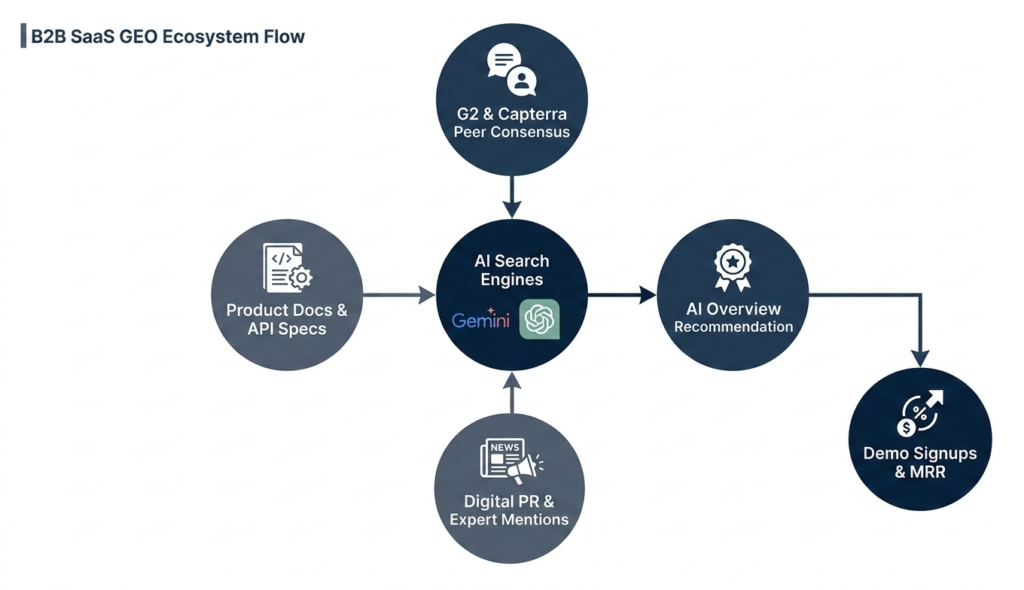
To dominate AI Overviews and LLM prompts, your strategy must pivot from ranking pages to becoming a trusted citation entity.
5 Strategies to Rank Your SaaS in Google AI Overviews & ChatGPT
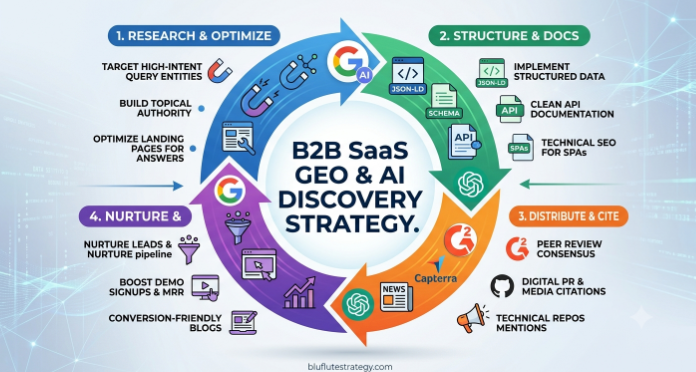
1. Optimize for “Entity Authority” & Third-Party Consensus
AI engines prioritize platforms backed by third-party consensus over self-promotional claims.
+————————————————————————————————————————-+
| THE 3-TIER AI CITATION ECOSYSTEM |
+—————————————————————————————————————————-+
| Tier 1: Peer Review Portals ► G2, Capterra, TrustRadius, Gartner |
| Tier 2: Technical Repositories ► GitHub, StackOverflow, API Specs |
| Tier 3: Industry Media ► TechCrunch, VentureBeat, Hacker News |
+———————————————————————————————–=—————————+
- Build Peer-Review Consistency: Maintain updated, highly-rated profiles on G2, Capterra, and TrustRadius. AI models extract review sentiment and key feature highlights directly from these platforms.
- Cultivate Digital PR & Unlinked Mentions: Secure coverage across tech media and industry blogs. LLMs track brand co-occurrences (e.g., pairing your brand name with terms like “best APM tool” or “enterprise SaaS”).
2. Implement Information Gain & Direct Answer Structures
AI Overviews crawl pages that provide concise answers without fluff.
- Use Clear “Is/Does” Definitions: At the top of product and feature pages, include a concise 40–60 word summary defining what your product does, who it serves, and its primary differentiator.
- Publish Proprietary Research: Share original benchmark reports, industry data, and original statistics. LLMs cite unique data points to back up generated statements.
3. Deploy Advanced Technical Schema & Structured Data
Machine-readable code helps LLMs categorize your software accurately.
- Implement SoftwareApplication Schema: Markup your product pages with precise attributes including applicationCategory, operatingSystem, offers (pricing), and aggregateRating.
- Standardize Technical Documentation: Maintain clean API documentation with clear structured headers (H2, H3) and JSON-LD markup to help AI engines interpret technical specs.
For complex Single-Page Applications (SPAs), partnering with a dedicated SEO company for IT SaaS India helps ensure JavaScript rendering issues do not block LLM web crawlers like GPTBot and Google-Extended.
4. Build Programmatic “Alternative To” & Comparison Pages
When prospective buyers use AI engines, high-intent prompts often follow comparison patterns:
- “Compare [Competitor A] vs. [Competitor B] for mid-market SaaS”
- “What is the best open-source alternative to [Legacy Software]?”
+———————————————————————————————————————–+
| RECOMMENDED COMPARISON PAGE STRUCTURE |
+———————————————————————————————————————–+
| 1. High-Level Feature Comparison Matrix (Markdown / HTML Table) |
| 2. Clear Use-Case Breakdowns (When to choose Brand A vs. Brand B) |
| 3. Transparent Pricing & Integration Details |
| 4. Schema-Optimized Pros & Cons Bullet Lists |
+——————————————————————————————————————– +
Creating structured comparison matrices on your website helps AI engines extract your points of differentiation and display them directly inside AI-generated comparison tables.
5. Ensure Crawlability for AI Search Bots
If AI web crawlers are blocked by your robots.txt file or server firewall, your platform will be omitted from real-time recommendations.
- Verify that your server permits access to key AI user-agents:
- GPTBot (OpenAI ChatGPT)
- Google-Extended (Google Gemini / AI Overviews)
- PerplexityBot (Perplexity AI)
- ClaudeBot (Anthropic Claude)
Turning AI Recommendations into Qualified Demo Requests
Getting cited in Google AI Overviews or ChatGPT is the first step; converting that visibility into pipeline revenue is the ultimate goal.
[ User asks AI Engine ]
│
▼
[ AI Cites Your SaaS Product ]
│
▼
[ User Lands on High-Intent Page ]
│
▼
[ High-Converting Lead Funnel ] ──► [ Demo Booked / Free Trial Started ]
When users click through from an AI Overview citation, they expect immediate clarity rather than top-of-funnel educational copy.
To maximize conversions on this traffic:
- Align Landing Page Headlines with AI Prompts: Ensure your landing page reinforces the exact value proposition highlighted in the AI recommendation.
- Remove Friction from Demo Forms: Offer single-click Google/LinkedIn SSO for product signups or simplified 3-field demo requests.
- Showcase Instant Social Proof: Display enterprise client logos, G2 badges, and real-time review widgets directly above the fold.
If your technical infrastructure or landing pages suffer from low conversion rates, exploring dedicated web development for IT companies helps turn organic search visitors into pipeline revenue.
Scale Your Organic Growth with Bluflute Strategy
Optimizing for the AI-driven search landscape requires a blend of advanced technical SEO, entity architecture, and product-led content strategy.
As a premier SaaS SEO agency in Delhi, Bluflute Strategy helps software startups, cloud platforms, and enterprise IT firms build organic pipelines globally across the USA, UK, and India.
+————————————————————————————————————————-+
| THE BLUFLUTE ADVANTAGE |
+————————————————————————————————————————-+
| • 285% Average Organic Traffic Growth for B2B IT & SaaS Clients |
| • 3.8x Average Return on Marketing Investment |
| • Deep Expertise in AI Search (GEO), JavaScript SEO, & Entity Mapping |
+————————————————– ————————————————————————–+
Our specialized services in SEO for software companies India bridge technical execution with B2B revenue goals (LTV:CAC, MRR, and Rule of 40). Combined with targeted PPC for IT companies, we deliver full-funnel acquisition strategies that scale software brands globally.
Ready to dominate AI Overviews and capture high-intent buyers?
Book a Free Strategy Call with Bluflute Strategy to receive a custom AI Search Visibility & Technical SEO Audit for your software platform.
Frequently Asked Questions
Q. What is Generative Engine Optimization (GEO) for B2B SaaS?
Ans. Generative Engine Optimization (GEO) is the process of optimizing website content, technical architecture, and online brand citations so AI search engines (like Google AI Overviews, ChatGPT, and Perplexity) select and recommend your software product in response to user queries.
Q. How does ChatGPT determine which software tools to recommend?
Ans.ChatGPT evaluates brand recommendations based on online consensus, structured entity data, third-party review platforms (G2, Capterra, TrustRadius), tech publications, open-source repositories, and consistent feature descriptions found across authoritative websites.
Q. Why partner with a specialized SaaS SEO agency in Delhi?
Ans. A specialized SaaS SEO agency in Delhi like Bluflute Strategy delivers global-grade technical SEO, AI search optimization, and conversion-focused content frameworks at an efficient cost structure—helping software companies in the US, UK, and India capture market share faster.