How to Choose the Best Website Development Company for Your Business (2026-2027 Checklist)
Your website is your hardest-working salesperson: it is open 24/7, it is the first thing prospects check, and it quietly decides whether they call you or a competitor. Yet most businesses pick a website development company based on a quick quote or a flashy portfolio, and then spend the next year fixing slow pages, weak SEO and missed leads.
This 2026-27 checklist will help you evaluate any web development partner with confidence. You will learn what to look for, which red flags to avoid, what to ask on a discovery call, and how to compare proposals fairly. If you want a team to build and grow your site end to end, explore our website development services.
Why Choosing the Right Website Development Company Matters
A website is not a one-time purchase; it is a business asset that affects ranking, conversions and brand trust. The wrong partner can cost you more than the original project fee:
• Lost leads: slow, confusing or non-mobile-friendly pages push visitors away within seconds.
• Poor search visibility: sites built without technical SEO struggle to rank, no matter how much content you add.
• Hidden costs: unclear scope leads to change requests, delays and surprise invoices.
• Security and maintenance risk: outdated plugins and weak hosting setups invite downtime and hacks.
Choosing well means your site pays for itself through enquiries, bookings or sales. Choosing badly means a rebuild within 12–18 months.
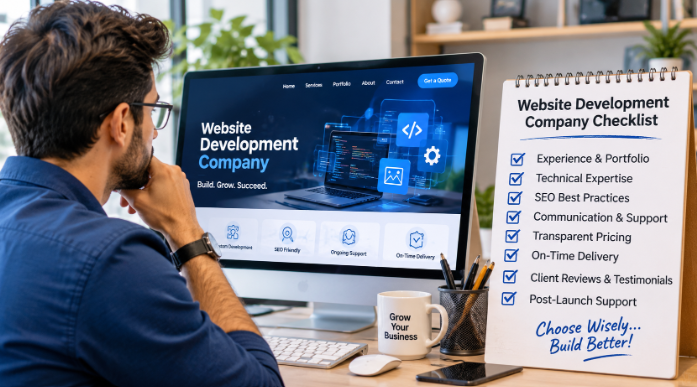
The 2026-27 Checklist: 10 Things to Check Before You Hire
1. Define Your Business Goal First
Before you contact any agency, write down what the site must achieve: generate leads, sell products, book appointments or support enquiries. A good website development company will ask about goals, audience and revenue targets before talking about design or technology. If the first conversation is only about price and page count, keep looking.
2. Review Their Portfolio and Case Studies
Look for live websites, not just screenshots. Open them on your phone, test the speed and check how easy they are to navigate. Prioritize companies with experience in your industry, for example website development for doctors, schools and institutes, enterprises or e-commerce brands. Industry experience shortens the learning curve and improves the result.
3. Make Sure SEO Is Built In, Not Bolted On
Rankings are decided by structure, speed and markup long before you publish a single blog. Ask whether the team handles clean URL structure, heading hierarchy, schema markup, XML sitemaps, image optimization and redirects as part of development. Better still, choose a partner that also offers SEO services, so your site is ready to rank from launch day.
4. Check Speed and Core Web Vitals Standards
Page speed affects both rankings and conversions. Ask what Core Web Vitals scores they target (LCP, INP and CLS) and how they achieve them: lightweight themes, image compression, caching, a CDN and minimal third-party scripts. Request PageSpeed Insights results from past projects.
5. Insist on Mobile-First, Responsive Design
Most of your visitors will arrive on a phone. The company should design for mobile first and test across real devices and browsers, not just resize a desktop layout. Look for thumb-friendly navigation, readable text and fast-loading forms.
6. Ask About Technology and CMS Choices
The right stack depends on your needs: WordPress for content-led sites, custom code or headless setups for complex products, Shopify or WooCommerce for stores. A trustworthy partner explains the trade-offs and never forces a platform just because it is the only one they know. Confirm that you will own the code, content and admin access.
7. Demand Transparent, Itemised Pricing
Compare proposals line by line: design, development, content, SEO setup, integrations, hosting, security, training and maintenance. Be wary of quotes that are far below the rest; they often exclude essentials that return later as add-ons. Ask what happens if you need extra pages or features mid-project.
8. Understand Their Process and Timeline
A reliable website development company can explain its process in plain language: discovery, wireframes, design, development, testing, launch and handover, with clear milestones and approval points. A typical 5–10 page business site takes roughly 3–6 weeks, while stores and custom builds take longer.
9. Look for Conversion-Focused Design
Beautiful is not enough. Your site needs clear calls to action, trust signals, fast forms, click-to-call and WhatsApp buttons, and tracking for every enquiry. Ask how they plan to measure results with Google Analytics 4 and Search Console, and whether they can connect the site to your paid campaigns such as PPC management.
10. Confirm Post-Launch Support and Security
Launch is the starting line. Ask about backups, uptime monitoring, security updates, bug-fix windows, content edits and ongoing optimisation. Good partners offer a clear support plan, with defined response times, so you are never left chasing a developer who has disappeared.
| Not Sure Which Website Partner Is Right for You?Get a free consultation with BluFlute Strategy. We will review your goals, your current website and the best way to build a site that ranks and converts.▶ Get Free Consultation |
Red Flags to Avoid When Hiring a Web Development Company
• No live portfolio, or work that cannot be verified.
• Guaranteed “#1 ranking” promises. No honest agency can guarantee this.
• Refusing to give you ownership of the domain, code or admin access.
• Vague quotes with no scope, timeline or revision limits.
• Ready-made, pirated or heavily nulled themes and plugins.
• No testing, no staging site and no backup plan.
• No mention of SEO, analytics or conversion tracking.
Questions to Ask on Your First Discovery Call
1. Can you show me three live websites similar to mine and the results they achieved?
2. Who will actually work on my project, and who is my single point of contact?
3. How do you handle SEO, schema, speed and mobile optimisation during the build?
4. What is included in the price, and what would cost extra?
5. Who owns the website files, content and accounts after launch?
6. What does your post-launch support and maintenance plan cover?
7. How will we measure the success of the website in the first 90 days?
Website Development Company vs Freelancer vs In-House Team
| Factor | Development Company | Freelancer | In-House Team |
| Skill range | Design, development, SEO, QA in one team | Usually one or two skills | Depends on hiring |
| Cost | Mid; predictable | Lowest upfront | Highest (salaries) |
| Reliability | Backup if someone is unavailable | Single point of failure | Stable, but capacity limited |
| Scalability | Easy to scale up | Limited | Slow to scale |
| Best for | Growing businesses and long-term projects | Small, one-off tasks | Large product companies |
What Does a Website Development Company Do for Different Industries?
Good partners tailor features to how your customers behave. For example:
• Doctors and clinics: appointment booking, treatment pages and a secure setup. See web development for doctors.
• Schools and institutes: admission forms, course pages, notice and event management. See web development for schools.
• E-commerce: product pages, payment gateways, checkout optimisation and inventory management. See e-commerce web development.
• Enterprises: multi-location structures, custom back ends and CRM integration. See enterprise web development.
Beyond Launch: Turn Your New Website Into a Lead Machine
A new site needs traffic to create value. Plan from the start how visitors will arrive: organic search through SEO, paid campaigns through PPC, and audience building through social media optimisation. If you serve a specific area, local SEO for small businesses helps you appear in map results and “near me” searches. Bringing these together under one team keeps your messaging, tracking and budget aligned.
Keep learning: read more growth guides on the BluFlute Strategy blog, including how to improve your website conversion rate, a technical SEO checklist for new websites and local SEO tips for small businesses.
Final Thoughts: Pick a Partner, Not Just a Vendor
The best website development company for your business is the one that understands your goals, builds SEO and speed into the foundation, prices openly and supports you after launch. Use the checklist above to shortlist two or three options, ask the discovery-call questions, and compare proposals on value rather than price alone.
Ready to build a website that ranks, loads fast and converts? The BluFlute Strategy team can help you plan, build and grow it.
| Book Your Free Website Strategy CallTalk to our team about your goals, timeline and budget. No obligation, just clear next steps.▶ Book Free Strategy Call |
Frequently Asked Questions (FAQs)
How do I choose the best website development company for my business?
Start with your business goal (leads, sales, bookings), then shortlist companies that have proven work in your industry, a clear process, transparent pricing, SEO built into development, and post-launch support. Check live portfolio sites for speed and mobile performance, and speak to past clients before you sign.
How much does website development cost in India in 2026?
Costs vary with scope. As a rough guide, a simple business website is usually the lowest tier, a custom multi-page or lead-generation site sits in the middle, and e-commerce or enterprise builds with integrations cost the most. Always ask for an itemised quote covering design, development, SEO setup, hosting, and maintenance so you can compare like for like.
How long does it take to build a business website?
A standard 5–10 page business website typically takes 3–6 weeks. E-commerce stores and custom web applications can take 8–16 weeks or more, depending on features, integrations, and how quickly content and feedback are provided.
Should I choose a freelancer or a website development company?
A freelancer can suit a small, one-off project. A website development company is usually the safer choice when you need design, development, SEO, security, and ongoing support from one accountable team, plus continuity if a team member leaves.
What should be included in a website development proposal?
A strong proposal lists scope and deliverables, timeline and milestones, technology stack, SEO and speed requirements, content responsibilities, payment schedule, ownership of code and assets, testing process, and post-launch support terms.
Why is SEO important in website development?
If your site is not built with SEO in mind (clean structure, fast loading, mobile-first design, schema markup, optimised URLs), you will spend more later to fix it. Choosing a company that combines development with SEO services helps your site rank and generate leads from day one.